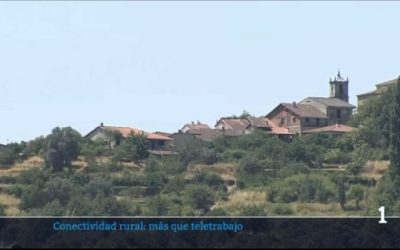
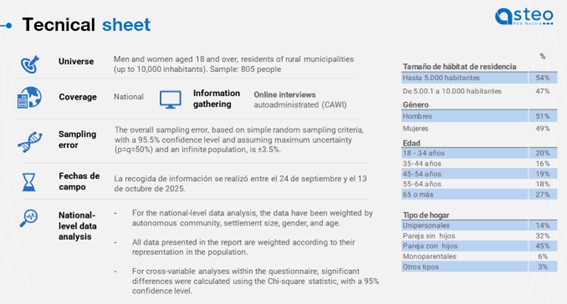
The annual study conducted by Observatorio Asteo is based on a survey of Internet users living in rural areas with fewer than 10,000 inhabitants. It analyzes the digital environment and quality of life in rural communities across Spain, with a particular focus on municipalities with fewer than 10,000 and 5,000 residents.
-
Seven out of ten respondents believe that home digitization (teleassistance, fall or motion sensors, basic home automation, etc.) can help improve the lives of the elderly in rural areas
-
The use of teleassistance, motion sensors, and basic home automation is perceived as a help for the elderly to reside in their homes for longer (70%)
-
People over 65 years old are the ones who give the most importance to these tools (77%)
-
Only 7% of Internet users in rural areas are aware that Spain is one of the leading countries in fiber optic coverage in the European Union
-
The use of Artificial Intelligence among Internet users in rural areas has increased by more than ten points compared to last year, reaching 43%
-
70% of rural residents surveyed report having seen or received fake news online at least once this 2025
-
72% agree that in rural areas it is essential to have a high-speed connection to have a good quality of life
-
Internet-connected households in rural areas are predominantly composed of couples, with or without children (55%). In 24% of households, there are minors in the family unit, and 68% of homes with Internet users have more than one person living in the household. This profile also highlights those most at risk of being left behind in terms of connectivity: single-person households
The Annual Report from the Observatorio Asteo, titled Overview of the Digital Environment and Quality of Life in the Rural World” indicates that 70% of respondents strongly agree or somewhat agree (24%) that home digitization would help the elderly remain in their homes longer and improve their daily lives in these areas. According to the survey conducted by the Asteo Observatory and Random Strategy, seven out of ten internet users in rural areas (69%) state that the digitization of homes, through the use of teleassistance, motion sensors or home automation, would improve the quality of life of elderly people residing in these areas.
The 2025 report notes that, although “Smart Home” is still in its early stages in rural areas, with 25% of connected homes having some home automation device or smart appliance, these tools are considered fundamental for the future of small municipalities. 20% state that they are interested in incorporating them in the future.
Internet-connected households in rural areas are predominantly composed of couples, with or without children (55%). In 24% of households, there are minors in the family unit, and 68% of homes with Internet users have more than one person living in the household. This profile also highlights those most at risk of being left behind in terms of connectivity: single-person households. The analysis does not differentiate by age or gender, as these variables were fixed to reflect the general demographic characteristics of rural areas.
High-Speed Internet Access Compared to the Rest of Europe
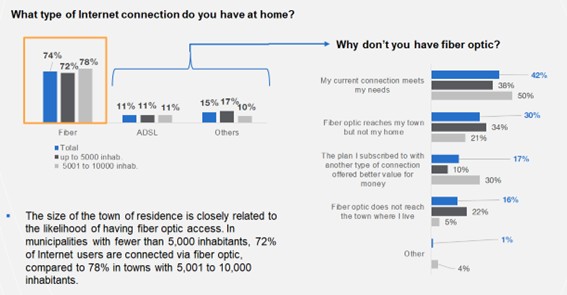
74% of the houses of Internet Users surveyed have optic fiber connection. Nevertheless, The size of the town of residence is closely related to the likelihood of having fiber optic access. In municipalities with fewer than 5,000 inhabitants, 72% of Internet users are connected via fiber optic, compared to 78% in towns with 5,001 to 10,000 inhabitants.
Among the 26% who do not have fiber, the main reasons cited are: their current connection meets their needs (42%), fiber optic reaches the town but not their home (30%), or the commercial plan they subscribed to with another type of connection is more suitable for them (17%), among others (multiple responses allowed).
According to the survey, only 7% of Internet users in rural areas are aware that Spain is one of the leading countries in fiber optic coverage in the European Union.
For 72% of respondents in rural areas, having a high-speed connection is essential to have a good quality of life. This consensus spans all segments, although it is more pronounced among the elderly (85%) and residents of the smallest municipalities (76% in towns with fewer than 5,000 inhabitants).
58% of users state that they would move homes if their home did not have a high-speed connection. Those most inclined to move are those under 35 (66%), those who work (57%), and those who telework (76%).
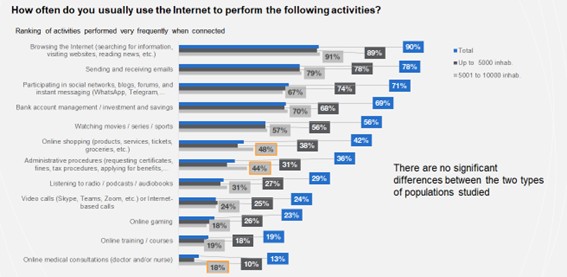
Most frequent online activities include: browsing the Internet (90%), sending emails (78%), social media use (71%), online banking (69%), streaming movies (56%), online shopping (42%), administrative procedures (36%), podcasts/radio (29%), video calls (24%), online gaming (23%), online training (19%), and online medical consultations (13%).
Online medical consultations rank last, although they have increased compared to the previous year.
Use of Artificial Intelligence and Contact with Fake News
It is noteworthy that the use of Artificial Intelligence in rural areas has increased by more than ten points compared to the previous year. While in 2024 only 3 out of 10 users acknowledged having used artificial intelligence tools, in 2025 this percentage has risen to 43%.
Young people and middle-aged adults in rural environments are the ones who report having used these tools to a greater extent than the rest, while among the elderly only one in ten acknowledges being up to date with these technological trends.
Searching for information or resolving doubts remains the most prominent reason for using this technology, at 76%, followed by use for professional purposes (39%), entertainment (33%), or educational activities (28%).
In this area of information searching, 70% of rural residents state that they have seen or received fake news online at least once. 25% say they have received these fake news frequently, while 44% only sporadically.
These data reflect high exposure to disinformation in the rural environment, underscoring the need to strengthen digital skills to identify reliable sources and address the risks associated with the spread of fake news or rumors. Regarding what they do when they doubt a news item, 66% state that they consult several reliable verification sources, while one in five says they do nothing.
Entrepreneurship and Teleworking
Entrepreneurship in rural areas is a tool that can improve opportunities for those residing in these areas. This is understood by three out of four respondents (74%), who also consider connectivity as a key strategy against unemployment and depopulation in these populations.
Compared to the rest of Europe, 46% of respondents place Spain in a good position in terms of facilities for residents in rural areas to start businesses. Only 8% consider that this is not the case, and the remaining 46% state that they do not know if it is easier or harder to start a business in Spain than in other European countries.
The Observatory’s report indicates that only one in four rural workers (23%) currently has the option to telework in their job. In fact, among all working residents, the vast majority (77%) state that their company does not allow remote work.
Regarding the perception of teleworking as a tool for rural development, the consensus is very broad: approximately 4 out of 5 respondents (86%) believe that remote work is a relevant factor for retaining population in small municipalities. For those who telework, it is 99%.
Asteo Red Neutra is supported by the private infrastructure fund CEBF (Connecting Europe Broadband Fund), which focuses on investing in the development of ultra-broadband networks to extend connectivity across rural and semi-rural areas in Europe.